Feature Overview
Data coverage
New Energy Terminal is an open market intelligence platform for clean energy research, currently focusing on the battery value chain. We provide live datasets updated on a daily basis.
Our data is sourced from public channels, such as news outlets, government disclosures, company announcements, and annual reports. It is important to note that we exclusively rely on non-confidential information and ethical data sources.
We specifically track energy assets and company datasets. Our purpose-built database provides the granularity required for data visualization and in-depth analysis.
Energy assets
We track each energy asset throughout its lifecycle within a circular value chain, from manufacturing, procurement, and financing to deployment and retirement, including potential recycling stages.
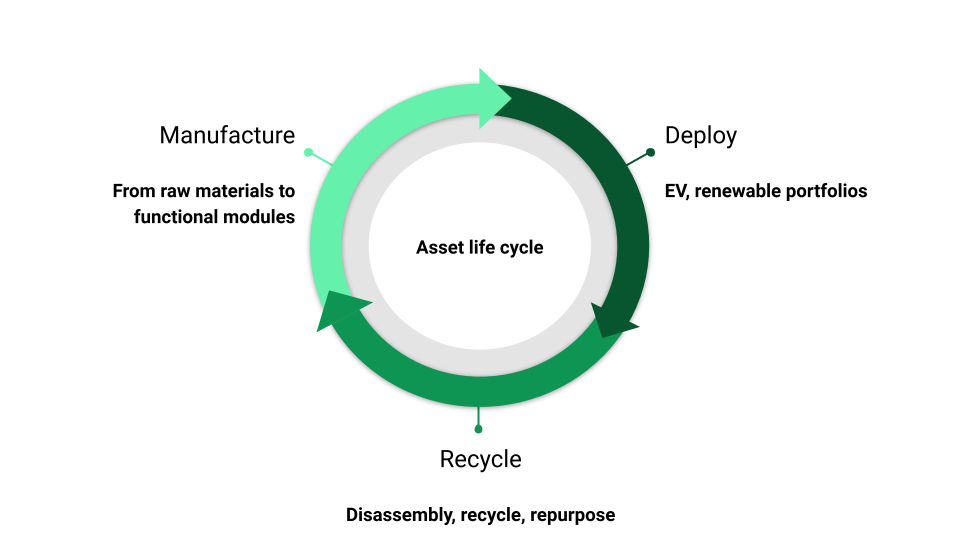
At present, our system closely monitors manufacturing plants, which are facilities that produce components and modules for electric vehicles, energy storage systems, and renewable energy projects such as solar and wind farms. We cover the entire lifecycle, including component production, recycling, and metal compound extraction.
This enables a detailed understanding and analysis of each energy asset in our database, supporting informed decision-making.
Key information
- Location and operator: Geographic location and managing organization of the asset.
- Asset details: Includes the asset type (e.g., solar farm, wind farm), capacity, phase, status, and technical specifications.
- Project participants: Identifies involved entities and stakeholders, including equipment providers.
In the future, we may expand coverage to a broader range of sustainable energy assets, including solar farms, wind farms, energy storage projects, and renewable energy portfolios.
Related companies
We methodically record data on companies associated with energy assets, categorizing them by their roles:
- Refiner, manufacturer, recycler: Companies actively involved in refining, manufacturing, or recycling processes related to energy assets.
- Developer, EPC (Engineering, Procurement, and Construction): Entities participating in project development and executing key functions in the engineering, procurement, and construction phases.
- Owner, investor, utility, O&M (Operation & Maintenance), offtaker: Organizations performing pivotal roles as owners, investors, utilities, operators responsible for ongoing maintenance, and offtakers within the energy sector.
This meticulous capture of company data enables us to establish a comprehensive understanding of the energy ecosystem, facilitating detailed analysis and providing valuable insights for our users.
Accessing and exploring data
There are three ways to explore and access our data: dashboards, the data library, and API access.
Dashboard
We offer a suite of dashboards designed to support research and insight generation. For example, the Manufacturing Dashboard focuses on manufacturing data across the electric vehicle (EV) and energy storage system (ESS) battery sectors.
In practice, you can perform geospatial analysis of battery-related projects and sectoral analysis across different products within the battery value chain.
Analytical capacbilities:
- Industry layout (geospatial mapping): Provides state/province-level mapping of energy assets for real-time operational status monitoring. Interactive elements include clickable scatter points with hyperlinks to asset profiles.
- Sectoral statistics: Offers sector-specific navigation (e.g., batteries, components, recycling for Manufacture; energy storage, solar, wind for Deployment) with comprehensive data visualizations like stacked bar charts for power output comparison.
- Multi-dimensional analysis: Enables insights through various lenses (country, state/province, company) with customizable filters for detailed examination.
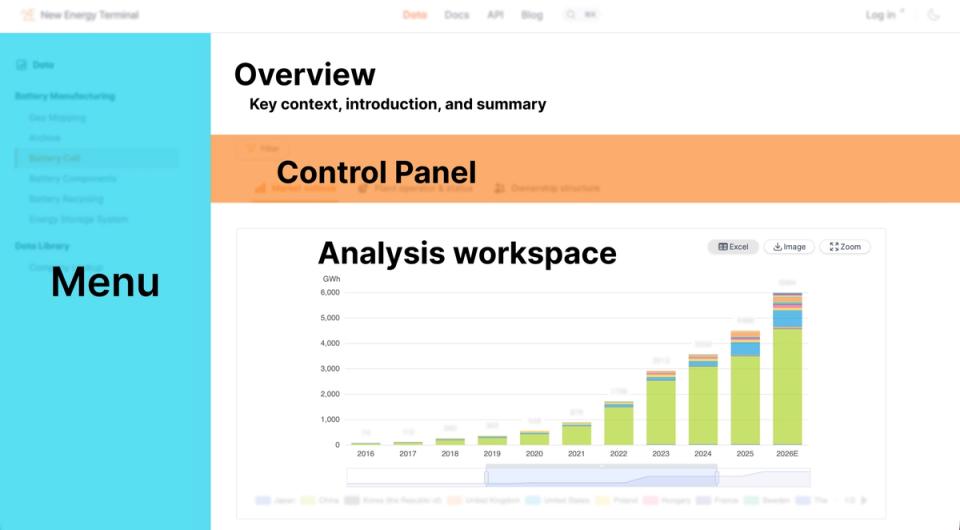
The dashboard is organized into four primary sections:
- Navigation Menu – Provides access to different modules and views.
- Dashboard Overview – Presents key context, introductions, and summary information.
- Control Panel – Enables filtering and exploration across multiple dimensions.
- Analysis Workspace – Displays interactive charts and visualizations, allowing you to zoom, download the current view, and export selected datasets.
Data library
Our company lookup catalogs stakeholders across the battery market, including battery and component manufacturers, automakers, and recyclers. You can explore each stakeholder's business segments and organizational structure, helping you better understand relationships between parent companies, subsidiaries, and affiliated entities.
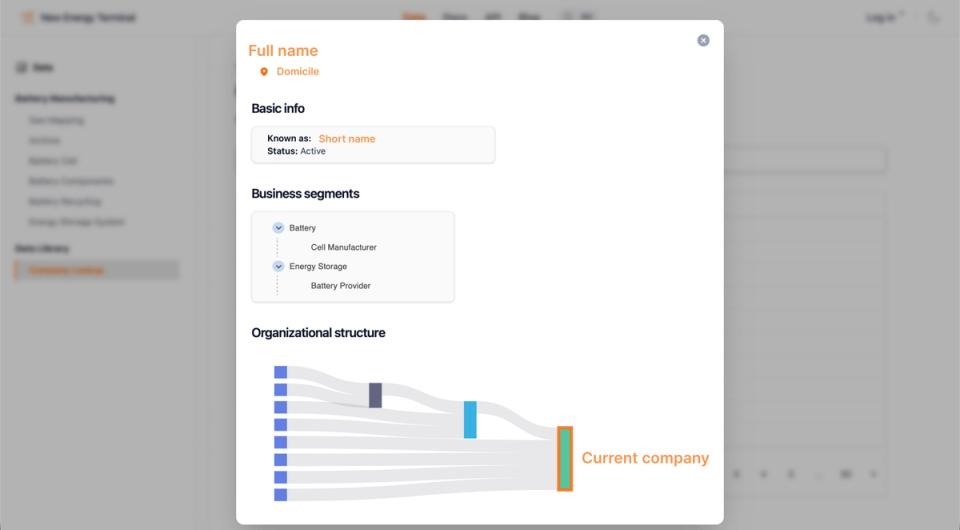
Companies are categorized according to their roles within the energy value chain, enabling users to quickly identify relevant stakeholders and analyze relationships across the ecosystem.
Key information:
- Basic information: Includes company name and domicile country, plus listing status.
- Business segments: Identifies the company's specific function(s) in the manufacturing, development, operation, and management of energy assets.
- Organizational structure: Details on the company's hierarchy and its parent/child relationships.
API access
You can obtain an API key and programmatically access our datasets through the Model Context Protocol (MCP). Please refer to our API reference documentation for implementation details.
// Retrieve available MCP tools
const tools = await mcpClient.tools();

// Use the tools with a model
const result = await streamText({
  model: provider('model-id'),
  tools,
  prompt: 'Anything new in battery?',
  onFinish: async () => {
    await mcpClient.close(); // Close the MCP client after use to release resources
  },
});
Where we are heading
To build meaningful features that align with our users’ needs, we move this project forward through a combination of data and user feedback, rather than following a rigid predefined roadmap.
The inception of this project dates back to early 2022, with the initial public release (v0.2) unveiled in November 2022. As of June 2026, we have moved on to the third version, denoted by v3.
Our latest focus is Data Engineering v2.0. We are onboarding more data related to global battery manufacturing across different product categories, including cells, components, and recycling. At the same time, we are building an automated data engineering pipeline to manage and process this growing dataset, while continuing to expand the number of data tools available through our MCP server.
Recommendations
All analyses on the platform are based on nominal manufacturing capacity, regardless of utilization rate. Therefore, the data should be used as an indicator of potential maximum supply within a given period.
Actual production volumes change over time and are heavily influenced by:
- Supply-demand dynamics
- Inventory levels throughout the value chain
- Company operating conditions
- Equipment performance
We recommend referring to official company reports when assessing actual production volumes. We also recommend reading the annual battery report published by Volta Foundation and subscribing to Intercalation Station's mailing list to stay informed about the latest developments and advancements in the battery industry.